Bluesky and the AT Protocol: How Data Servers, Relays and App Views Fit Together
Bluesky looks like Twitter from the outside. Underneath, it runs on the AT Protocol, an open design that splits a social network into separate jobs that different companies or people can run. For a publisher the split matters, because it decides who holds your posts, who decides what readers see and how you leave.
The AT Protocol and ActivityPub are often lumped together as "decentralized social media." They solve the problem in opposite ways. ActivityPub servers talk to each other directly, each keeping its own copy. The AT Protocol pours everything into big shared streams and lets anyone build on top.
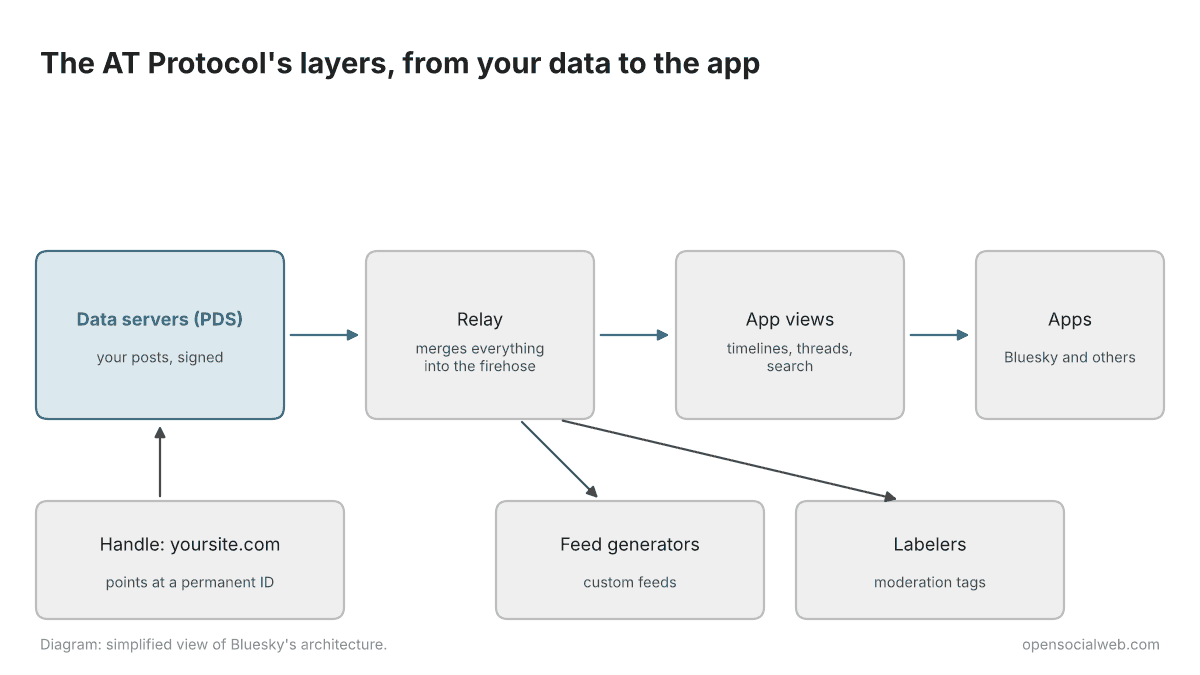
Diagram: Open Social Web, hosted at Pxef.com
The three layers
Personal data servers (PDS). Your account lives on one. It stores your posts, likes and follows as a signed data repository, a bit like a Git repo of your social life. Most people are on Bluesky's own servers, but anyone can run a PDS, and you can move your account between them.
Relays. A relay crawls every PDS it knows about and merges all the updates into one stream, called the firehose. It doesn't decide anything. It just collects.
App views. These read the firehose and build what users actually see: timelines, threads, notification counts, search. The Bluesky app is one app view. Others can and do exist, and several apps already show the same posts in different ways.
On top of that sit feed generators and labelers. A feed generator is a service that picks posts for a custom feed, such as "new posts about woodworking" or "people I follow, links only." A labeler tags content, and users choose which labelers to trust. Both can be run by anyone. That's how Bluesky handles both discovery and moderation without one central ranking or rulebook.
Identity: your domain or a portable ID
Every account has a permanent ID, a DID, which looks like did:plc: followed by a string of letters. Your handle is a readable name pointed at that ID. By default it's name.bsky.social, but you can set it to a domain you own, like yoursite.com, by adding a DNS record or a small file to the site.
For a publisher, the domain handle is the single most useful setting on Bluesky. It proves the account belongs to the site, it's easy to remember, and it doesn't depend on Bluesky's own domain. If you change PDS hosts, the DID and the handle come along, and so do your followers.
What it means for distribution
A few practical points, as of November 2026:
- Links get a fair shot. Bluesky shows link cards, and the default Following feed runs in time order, so a link post isn't buried by a ranking model there. Custom feeds can even be built around links.
- There's a 300-character limit for posts, so you share a link with a line or two, not a full article.
- Every public profile has an RSS feed. Add
/rssto a profile URL on bsky.app and you get a feed of that account's original posts. Handy for monitoring, and for pulling your own Bluesky posts back onto your site. More on feeds in RSS for Publishers. - Discovery runs through feeds. Getting into a popular topic feed can matter more than follower count.
Where it falls short
The design is open, but in practice most of it still runs on Bluesky's infrastructure: the main relay, the main app view, most accounts' data servers. Moving your account is possible on paper and getting easier, but few people do it. The protocol allows a lot of independence. Using it takes work.
The AT Protocol also doesn't speak ActivityPub. A Bluesky account can't follow a Mastodon account directly. Bridges fill the gap, mainly Bridgy Fed, which is opt-in on both sides.
Should a publisher bother
If your readers are on Bluesky, yes, and the setup is small: an account with your domain as the handle, posts linking to new articles, maybe your feed piped in automatically. It fits the POSSE pattern: your site stays the original, Bluesky is one place you syndicate to.
If you want one account that reaches both networks, start with the fediverse side and bridge it. The three protocols are compared side by side in ActivityPub vs AT Protocol vs Nostr, and ActivityPub Explained for Website Owners covers the other half.